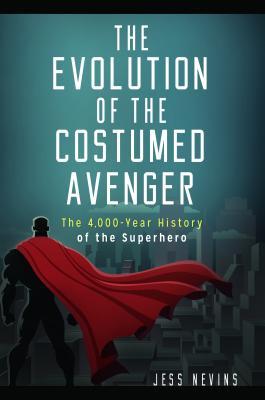
I was aware of this book when it came out, but as a niche publication in hardcover it was pricey. I’ve been watching used prices for about a year and finally decided now was the time to pick up a copy while they were still sold in good shape.
This is a very detailed history of the forerunners to the comics superheroes. The first Seven of Nine chapters break out various eras before the publication of Superman in Action Comics #1, 1938. Discussed briefly are a wide range of heroic characters from Gilgamesh to Robin Hood to Long Meg, Spring-Heeled Jack to John Carter, the Scarlet Pimpernel to the Domino Lady. I had never heard of many (most) of them and quite frankly glossed over much of the descriptions as much as I read some with interest. However, I think the value of having one place that discusses all of these hero/adventure characters in one place is interesting.
What Nevins does is react to these characters against a “formula” of his own devising. By his reasoning you don’t need all of these to be a ‘superhero’; the two main types he establishes as “Costumed Avenger” (without powers) and “Ubermensch” (with powers). Since it’s not an all-or-nothing checklist, it’s hard for anyone else to disprove his reasoning, either.
His list of criteria:
- Unusual origin story
- Superpower
- Extraordinary skills and abilities
- Extraordinary technology
- Distinctive weapon
- Distinctive appearance
- Code name
- Dual identity
- Heroic mission (which must be “selfless”)
- Extraordinary opponents
- Lives in a world in which there is law enforcement and government
- Operates in a world in which crime/oppression/evil is clear cut and obvious
- Operates in a world in which law enforcement/the government is not capable of controlling or defeating crime/oppression/evil
- Operates under the assumption that law enforcement/the government is capable of holding and confining a criminal once they are apprehended
- Operates under the assumption that vigilantism is welcome or at least tolerated by general society as well as law enforcement and the government
- Is finite and can be killed (otherwise the figure is not a superhero, but a “superbeing”)
- Does not kill
Once you get to the last two chapters, the discussion of ‘evolution’ is largely put aside and the book becomes a fairly standard recitation of comic book history and publishing, delving into movies and TV as well.
The last part of the book that I will highlight is that that Nevins breaks the comics eras down in 15-year cycles:
- The Golden Age (1935-1949)
- The Atomic Age (1949-1956)
- The Silver Age (1956-1970)
- The Bronze Age (1970-1985)
- The Modern Age (1986-2001)
- The Metamodern Age (2001-2015)
As I was reading the book I was put off by the notion of an Atomic Age sandwiched in between Golden and Silver Ages, but with a little investigation I found this is something that is readily discussed if not universally accepted in comics fandom and scholarship. I don’t really like the distinction but it does fit well.
Since the book was published in 2017 Nevins noted that a new Age had started but didn’t attempt to name it. I will cheekily suggest that this is the IP Age (2016-2031) given the shift to digital publication where it’s now possible to completely read comics without owning them permanently.
I think if you are a serious fan of comics scholarship that this is a useful book to have on your shelf. Time will tell if, or how often, I pick it up again for reference.