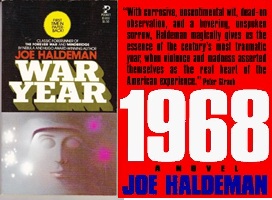
War Year (1972) and 1968 (1994) by Joe Haldeman

I don’t normally post dual reviews, but I think this one lends well to a comparison.

War Year was Joe Haldeman’s first published novel.  It is not in the science fiction genre he is a Grand Master of.  I believe it is a thinly-veiled account of much of his Viet Nam service as a combat engineer.  1968, however, takes his experience and allows him to paint a broader picture of the time, with a main character who is at home.

War Year is not a long work; easy-to-read and in the vernacular of soldiers in the thick of it, but with enough explanation for those who haven’t served.  1968 uses an omniscient narrator at times with a 1990s perspective and multiple points-of-view that no one character could know.

For War Year, I  read the Kindle version keeping the paperback version in print. Doing a little research the original hardcover had a different (apparently longer) ending.  What I read was powerful.  Since I’m an acquaintance of Mr. Haldeman, I wrote and asked him why it was changed.  He said that the paperback (preferred ending) was “deemed too sad [by the editor]…too grim….too authentic.” (Haldeman’s emphasis.)  I’m probably not going to be able to read the hardcover version, but I recommend War Year.

I have always been fascinated by the Viet Nam War.  I was too young to really understand, but grew up in the time after it ended when America had to grapple with its place in history.

Haldeman covers this well in 1968.  The characters that stay at home (with Beverly being the lead one) deal with civil rights, free love, and violent demonstrations.  The main character, “Spider” Spiedel is a draftee who serves as a combat engineer (as Haldeman did). Where the book diverges from his own experience (I assume) is that Spider suffers from intense PTSD in making his way stateside after his discharge.  There are some intense sections of both the combat experience and life back in the states.  My biggest complaint is that the book glosses over Spider’s adjustment time, not giving it the same depth as the combat experience.  Maybe that’s because of the constraint of titling the book as one year’s experience, but the book just….ends.  I am curious what happened to Spider and to his ex-girlfriend Beverly.

Ripple Effect by David Gerrold & Ctein (2024, Patreon)

I read the excerpt “Bubble and Squeak” from the collection G is for Gerrold.  Here’s the thing: it’s the best part of the book, talking about a relationship between two characters and what happens.  Do look it up!  The format of the book overall is one of rotating perspectives following a large cast of characters.  This is a disaster book, and at first it reminded me of Lucifer’s Hammer by Niven & Pournelle, but that book gets to the “what next” stage after a disaster.  Ripple goes into great detail about a cataclysmic earthquake/tsunami but stops as the disaster ends.

One of the reasons I wanted to write about this book, though, is that it’s the first one that I have read through Patreon support.  They were releasing monthly chapters but I ‘cheated’ and waited a couple of months until the entire set was published as I found out about the book fairly late.  They offered a full download for anyone who was a $7/month payer, so I joined for a month and downloaded the book.  It’s a no-frills PDF, and there are a few typos, but it’s a really good value going right to the authors!

Patreon support: thumbs-up

The book as a whole: read the short story unless you are a Gerrold completist.

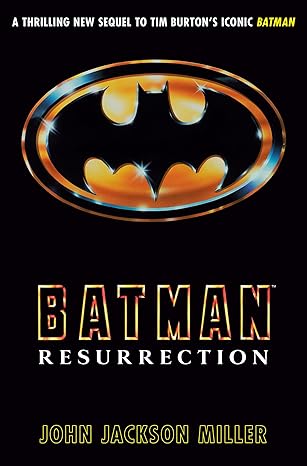
Batman Resurrection by John Jackson Miller (2024)

I thank the deals service BookBub telling me about this one, as it came up  on sale a couple of months ago.  The book takes place very soon after the end of the events of the first Tim Burton Batman movie (1989). If you are familiar with what DC has done with the rebrand of the property as “Batman ’89” (to distinguish from Adam West as “Batman ’66”) this book is adjacent but not related to the comics works published by DC using the Burtonverse.

Miller is a skilled tie-in author (I’ve enjoyed his Star Wars books) and I think he got the vibe of the characters and performances from the movies. This was not hard to read and better than many of the prose superhero novels I’ve consumed.

The best thing about the telling here is that Batman is still pretty new and he is still testing out some of his “wonderful toys”.  That’s not a side that we often see, and as a long time fan I enjoyed it immensely.  Miller is filling in the space between the  movies Batman and Batman Returns.

The book went on sale because he wrote another one, so I will be looking for that one to also go on sale once it’s been a while.  Worth picking up.